
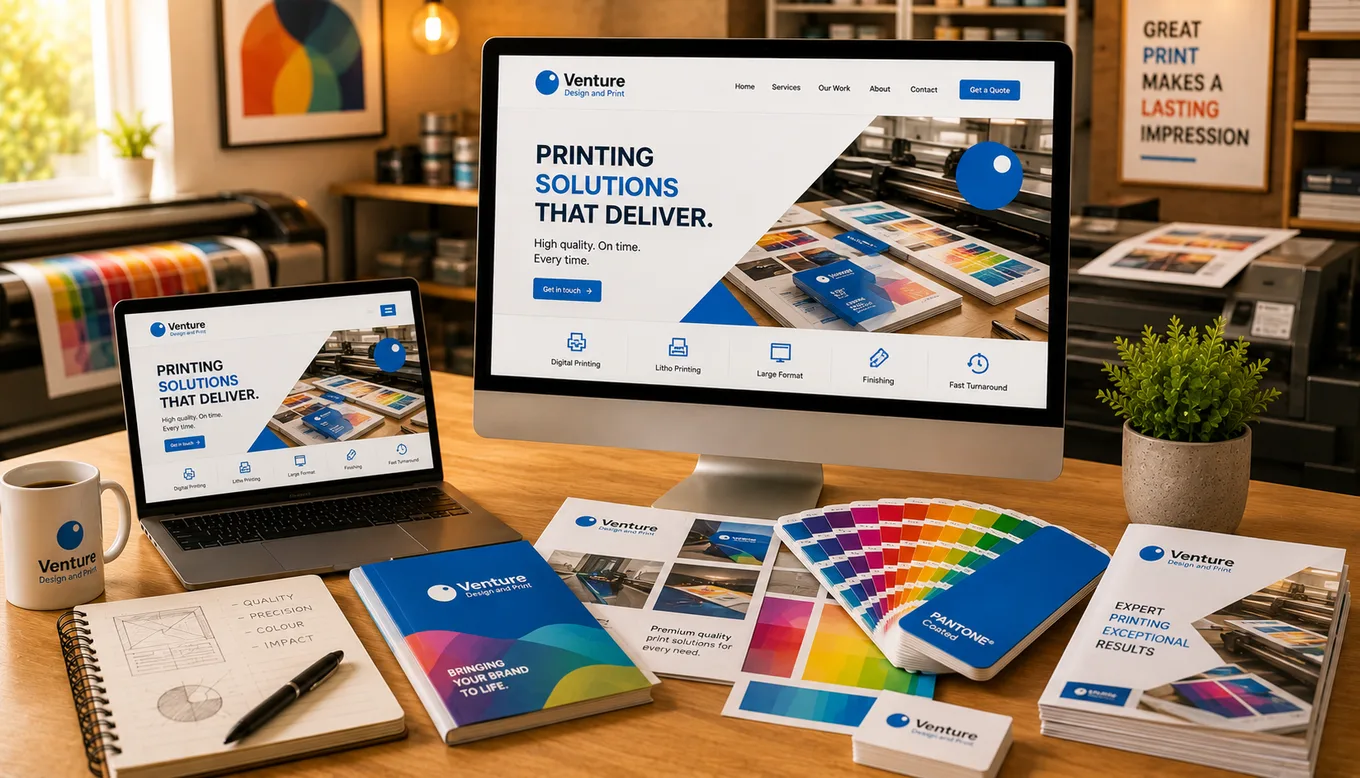
Printing Services in Lincolnshire
Print remains an important part of how businesses communicate, promote products, support sales teams and present themselves to customers.
From brochures, leaflets and business stationery to packaging, labels, exhibition materials and larger promotional requirements, printed materials provide something physical that customers can see, handle, keep and refer to.
Venture Design and Print provides professional printing services in Lincolnshire for businesses requiring anything from an individual print project to ongoing support across a wider range of marketing materials.
Commercial Printing for Lincolnshire Businesses
Different businesses use print in very different ways.
A manufacturer may require technical literature and product catalogues. A professional organisation might need corporate brochures and stationery, while a retailer could depend upon promotional leaflets, posters and point-of-sale material.
Lincolnshire’s food producers may require labels and packaging, and businesses attending exhibitions or agricultural events can need everything from sales literature to large-format displays.
Printing for the Intended Purpose
The most appropriate print specification depends upon how the finished item will be used.
Paper or material, size, quantity, finishing and production method can all influence the appearance, durability and cost of the finished product.
Rather than treating every requirement in the same way, the specification can be selected around what the printed material actually needs to achieve.
From Short Runs to Larger Print Quantities
Not every business needs thousands of copies of everything it produces.
Digital production has made shorter print runs practical for many applications, while larger quantities can benefit from alternative production methods where appropriate.
Choosing an Appropriate Print Method
The right production method depends upon the artwork, quantity, specification, turnaround and intended use.
A short run of presentation brochures has different requirements from thousands of promotional leaflets or an extensive product catalogue.
Selecting the appropriate method helps balance quality, practicality and cost rather than automatically using the same production process for every project.
Print Quality and Business Presentation
Printed material becomes a physical representation of the organisation that produced it.
Customers notice the quality of a brochure, business card, catalogue or piece of packaging even if they do not consciously analyse the reasons behind it.
Paper choice, reproduction quality, finishing and attention to detail can all influence that impression.
Matching Quality to the Business
The most expensive specification is not automatically the best one.
A high-volume promotional leaflet needs to be economical enough to distribute widely, while a corporate brochure intended for an important sales presentation may justify a more substantial stock or specialist finish.
The objective is to choose a specification appropriate to the purpose and the impression the business needs to create.
Printing and Graphic Design Working Together
Good print begins before anything reaches the printing press.
Artwork needs to be designed and prepared with the finished product in mind, taking account of dimensions, folds, binding, colour, image quality and any specialist production requirements.
Designed for Production
Because Venture Design and Print provides both professional graphic design and printing services, these considerations can be addressed from the beginning of a project.
This can reduce problems between design and production while allowing paper choices, formats and finishes to contribute positively to the finished design.
Businesses that already have completed artwork can also supply files for printing, provided they meet the appropriate production requirements.
Print as Part of Wider Business Marketing
Printed communication does not operate separately from websites and digital marketing.
A customer may receive a leaflet and visit the website, pick up a brochure at an exhibition and make contact later, or encounter product packaging after making an online purchase.
Print therefore forms part of a much wider customer experience.
For Lincolnshire businesses using a combination of physical and digital marketing, maintaining consistency between those channels can strengthen recognition and create a more professional overall presentation.
Printing Support for Businesses Across Lincolnshire
Lincolnshire contains an unusually varied mixture of businesses, from agriculture, food production and manufacturing to tourism, retail, hospitality and professional services.
Each sector has different printing requirements, and those requirements can change as the organisation develops.
Professional printing is therefore not simply about putting ink onto paper. It is about determining what needs to be produced, how it will be used and the most appropriate way of turning the artwork into a finished product.
Venture Design and Print provides printing services throughout Lincolnshire, combining production knowledge with graphic design experience to help businesses create printed materials appropriate to their customers, their brand and their commercial objectives.
Printing for Lincolnshire’s Industries and Businesses
Lincolnshire’s economy combines long-established industries with modern manufacturing, logistics, tourism, retail and professional services.
That diversity creates an equally varied demand for commercial print.
A food producer preparing products for retail has very different requirements from an engineering company producing technical literature. A coastal attraction may need high-volume promotional materials, while a professional organisation might place greater emphasis on corporate brochures, presentation folders and stationery.
Professional printing services in Lincolnshire need to accommodate those differences rather than treating every business and every print project in the same way.
Printing for Agriculture and Rural Businesses
Agriculture remains closely connected with Lincolnshire’s identity and economy.
Farms, agricultural contractors, machinery businesses, suppliers and organisations supporting the rural economy use printed materials for sales, promotion, technical communication and events.
Agricultural Sales and Marketing Literature
Brochures, product sheets, catalogues and leaflets can help businesses communicate equipment, services and product ranges to customers.
Where products are technically complex, printed literature also provides space for specifications, comparisons, diagrams and other detailed information that customers may want to retain for future reference.
Agricultural Shows and Events
Shows, demonstrations and agricultural events create additional print requirements.
Businesses attending these events may require brochures, leaflets, business cards, promotional materials, banners and other items that work together as part of a coordinated presence.
Planning those materials together can provide greater consistency while helping ensure the right information is available at different stages of the customer conversation.
Printing for Lincolnshire’s Food Industry
Lincolnshire has strong connections with food growing, processing, manufacturing and distribution.
Businesses within this sector can require print at several stages between production and the finished product reaching the customer.
Labels and Product Packaging
Labels, sleeves, cartons and other printed packaging can identify products while communicating branding and essential information.
Different products within the same range may require individual variations while maintaining enough visual consistency for customers to recognise the overall brand.
Promotional and Trade Materials
Food businesses selling through retailers, distributors, hospitality or direct to consumers may also require brochures, product sheets, exhibition materials and other sales literature.
Print can therefore support both the physical product and the marketing activity surrounding it.
Printing for Manufacturing and Engineering
Manufacturing and engineering remain particularly important within parts of Lincolnshire and the wider Humber region.
Companies operating in these sectors often need printed communication that can accommodate substantial amounts of technical and commercial information.
Product Catalogues and Technical Literature
Catalogues can organise large product ranges into a format customers can navigate and retain.
Specifications, dimensions, product codes, photographs and technical information can be reproduced consistently across individual pages or complete ranges.
Smaller technical sheets can also provide focused information for individual products, processes or capabilities.
Corporate and Sales Brochures
A corporate brochure can communicate more than individual products.
Facilities, machinery, accreditations, sectors served, experience and specialist capabilities can all contribute to the way prospective customers assess a supplier.
A professionally produced brochure gives sales teams a physical document that can continue representing the business after a meeting or exhibition has finished.
Printing for Tourism and Hospitality
Lincolnshire’s visitor economy creates another substantial market for printed communication.
Businesses around the coast, Lincoln, the Wolds and the county’s historic towns use print before visitors arrive and throughout their stay.
Brochures and Visitor Literature
Accommodation providers, attractions and tourism organisations can use brochures and leaflets to promote experiences, facilities and destinations.
These materials may be distributed through visitor centres, accommodation, attractions, events and other locations where potential customers are actively looking for things to do.
Menus and Hospitality Print
Restaurants, cafés, hotels and other hospitality businesses have more practical everyday requirements.
Menus, drinks lists, promotional cards, information sheets and other printed items need to look appropriate to the business while also being suitable for regular handling and replacement.
Printing for Retail Businesses
Retailers use print both to promote products and to influence customers within the physical shopping environment.
Seasonal promotions, product launches and special offers can all create requirements for printed marketing.
Posters and Point-of-Sale Materials
Posters, display cards and other point-of-sale materials can highlight particular products or promotions at the point where customers are making purchasing decisions.
The specification can be adapted according to whether materials are intended for short campaigns or longer-term use.
Leaflets and Direct Promotions
Leaflets provide an economical way to communicate offers, services and events to a wider audience.
For businesses distributing significant quantities, the print specification needs to balance visual quality with the practical cost of each individual piece.
Printing for Professional Services
Accountants, solicitors, consultants, property businesses, financial organisations and other professional services often require a different type of printed communication.
Here, presentation and consistency can be particularly important because the material contributes directly to perceptions of the organisation.
Corporate Stationery
Business cards, letterheads, compliment slips and other stationery can provide a consistent physical expression of the company identity.
Even as business communication becomes increasingly digital, printed stationery remains useful in situations where documents, correspondence or personal contact require a more formal presentation.
Presentation Folders and Corporate Literature
Presentation folders can bring quotations, proposals, brochures and supporting information together in a professional format.
They are particularly useful where clients receive several individual documents during meetings, consultations or sales presentations.
Print for Businesses Serving National Markets
Being based in Lincolnshire does not mean a business serves only Lincolnshire customers.
Manufacturers, producers, specialist retailers and professional organisations throughout the county trade across the UK and internationally.
Their printed materials therefore need to represent the business effectively wherever they are received.
A brochure produced in Lincolnshire may be handed to a customer at a national exhibition. Packaging may appear on shelves hundreds of miles away, while a catalogue could remain on a buyer’s desk for months.
The value of professional print lies partly in that ability to continue communicating long after the initial contact has taken place.
Printing Appropriate to the Organisation
There is no single print specification suitable for every Lincolnshire business.
Quantity, purpose, audience, lifespan, distribution and budget all influence the most appropriate solution.
Understanding those factors allows paper, format, production method and finishing to be selected intelligently rather than simply choosing the cheapest or most elaborate option available.
For businesses throughout the county, this helps turn commercial printing into a practical part of marketing, sales and everyday communication.
Brochure, Catalogue and Leaflet Printing in Lincolnshire
Brochures, catalogues and leaflets remain some of the most versatile forms of printed marketing available to businesses.
They can introduce an organisation, explain services, present extensive product ranges or promote a particular offer. Unlike short-lived digital advertising, printed literature can be retained, passed to colleagues and referred to long after the initial contact with the business.
Venture Design and Print provides professional brochure, catalogue and leaflet printing in Lincolnshire, with specifications tailored to the purpose, quantity and quality required.
Brochure Printing
A professionally printed brochure can provide a substantial introduction to a business and the products or services it provides.
Brochures can range from compact promotional pieces to extensive corporate publications containing photography, detailed information, case studies and technical content.
Choosing the Right Brochure Specification
The appropriate size, paper and binding depend upon how the brochure will be used.
A document intended for an important sales presentation may benefit from a more substantial specification, while literature distributed in larger quantities at events may need to balance quality with unit cost.
The number of pages also influences the available production and binding options.
Paper and Board Choices
Paper has a significant effect on the appearance and feel of printed literature.
Weight, surface and finish can influence colour reproduction, photography, readability and the overall impression created by the finished piece.
Coated Papers
Coated stocks can provide strong colour reproduction and are frequently suitable for brochures, catalogues and other materials containing extensive photography or graphics.
Different finishes can create a glossier or more restrained appearance depending upon the design and intended use.
Uncoated Papers
Uncoated stocks provide a different tactile quality and can suit organisations looking for a more natural or understated appearance.
They can also be appropriate where the printed item needs to be written on.
The choice should complement the design and purpose rather than being made independently from them.
Brochure Binding
Multi-page brochures and catalogues can be finished using different binding methods according to their page count, size and intended lifespan.
Saddle-Stitched Brochures
Saddle stitching is commonly used for brochures and booklets with a suitable number of pages.
The pages are folded and secured through the spine, creating a practical format for company brochures, programmes, product literature and promotional publications.
Perfect-Bound Brochures and Catalogues
Documents with larger page counts may be suitable for perfect binding.
This creates a defined spine and a more book-like appearance, making it appropriate for substantial catalogues, reports and corporate publications.
The final choice of binding should be made alongside the page extent and paper specification so the different elements work together correctly.
Catalogue Printing
Catalogues are particularly valuable for Lincolnshire manufacturers, agricultural suppliers, distributors and businesses with substantial product ranges.
A printed catalogue allows customers to browse products without requiring access to a screen and can remain available in offices, workshops, showrooms and sales environments.
Product Catalogues
Catalogues can accommodate photographs, descriptions, specifications, product codes and other information across extensive ranges.
They can be produced as complete publications or supplemented with individual product sheets where ranges change frequently.
Shorter and Longer Print Runs
The quantity required can influence how a catalogue is produced.
Businesses may need relatively small numbers of specialist technical catalogues or considerably larger quantities for widespread customer distribution.
Selecting the production method around the required quantity helps ensure the specification remains commercially practical.
Leaflet Printing
Leaflets provide a flexible and economical way to promote businesses, products, services, events and offers.
They can be produced in numerous sizes and formats, from straightforward flat sheets to folded pieces containing several distinct panels of information.
Flat Leaflets
Flat leaflets work particularly well where the message is concise.
They can be used for promotions, menus, price lists, event information, product introductions and numerous other applications where information needs to be understood quickly.
Folded Leaflets
Folding creates additional panels and allows information to be divided into a more structured sequence.
Different fold configurations can be used depending upon the amount of content and how the reader should move through it.
This can make a relatively compact piece of print capable of communicating considerably more information without becoming visually overwhelming.
High-Volume Promotional Printing
Some campaigns depend upon distributing substantial quantities of literature.
Door drops, events, tourism promotions, retail campaigns and other mass-distribution activities may require thousands of printed leaflets.
Balancing Quality and Unit Cost
A specification appropriate for 100 brochures may be unnecessarily expensive for 20,000 promotional leaflets.
Paper weight, size, colour, finishing and production method can therefore be adjusted according to quantity and intended lifespan.
The objective is to maintain an appropriate standard while ensuring the cost per item remains sensible for the way the material will be distributed.
Specialist Finishes
Finishing can change both the appearance and physical characteristics of printed literature.
Where appropriate, additional processes can be used to give particular elements greater prominence or provide additional protection.
Lamination
Lamination can add a protective surface to covers and other printed items while also affecting their visual and tactile appearance.
Different finishes can create different effects, so the choice should complement the design rather than simply being added automatically.
Foiling and Other Decorative Finishes
Foiling and other specialist processes can highlight selected design elements and create contrast between different surfaces.
Used selectively, these techniques can add distinction to brochures, presentation materials and other premium applications.
They are most effective when considered during the design stage so the artwork takes advantage of the process rather than treating it as an afterthought.
Print Finishing and Folding
The final stages of production are just as important as the printing itself.
Trimming, creasing, folding, binding and other finishing processes determine how the completed item looks and functions.
Planning for the Finished Format
Artwork needs to take account of folds, page edges, binding and other physical characteristics from the beginning.
This is particularly important for folded leaflets and multi-page documents where information needs to remain correctly positioned after production.
Artwork for Brochures, Catalogues and Leaflets
Businesses can provide their own print-ready artwork or use Venture Design and Print for the graphic design as well as production.
Where artwork is supplied, it should meet the appropriate technical requirements for the intended print specification.
Where design is required, the publication can be developed around its eventual size, paper, binding and finishing from the outset.
Printed Literature That Continues Working
A brochure handed to somebody during a meeting can remain on their desk. A catalogue may be consulted repeatedly when products are required, while a leaflet can introduce a business to somebody who had not previously encountered it.
That longevity is one of the continuing strengths of printed communication.
For Lincolnshire businesses, professionally produced brochures, catalogues and leaflets provide a tangible way to explain what they offer while reinforcing the quality and identity of the organisation behind them.
Business Cards, Stationery and Corporate Printing in Lincolnshire
Corporate stationery remains an important part of the way many businesses present themselves.
Although much everyday communication now takes place digitally, business cards, letterheads, presentation folders and other printed materials continue to be used during meetings, sales presentations, correspondence, networking and face-to-face contact.
For businesses throughout the county, professional printing services in Lincolnshire can ensure these everyday materials reflect the same quality and identity as the organisation’s wider marketing.
Business Card Printing
A business card is one of the smallest pieces of corporate print, but it is often exchanged at an important point of personal contact.
It needs to communicate essential information clearly while providing a physical reminder of the individual and organisation after the conversation has ended.
Choosing the Right Business Card Stock
The weight and finish of the card influence how substantial it feels.
Different stocks can create very different impressions, from clean and contemporary coated boards to more tactile uncoated materials.
The appropriate choice depends upon the brand, artwork and way the cards will be used.
Single and Double-Sided Business Cards
Using both sides of a business card can provide additional space without overcrowding the principal contact information.
The reverse might carry supporting branding, additional contact details, a web address, QR code or another useful piece of information.
The objective should remain clarity rather than filling every available area simply because the space exists.
Letterhead Printing
Printed letterheads provide a consistent format for formal correspondence, quotations, contracts and other business documents.
They can incorporate the company identity and essential information while leaving sufficient space for the document itself.
Suitable for Office Use
Letterhead artwork and paper need to be appropriate for the way documents will subsequently be produced.
Where sheets will pass through office printers, the stock and printed coverage should be selected with that practical requirement in mind.
This allows businesses to maintain professional branded stationery while continuing to produce individual letters and documents internally.
Compliment Slip Printing
Compliment slips provide a simple way to include a short handwritten message with documents, samples, orders and other correspondence.
Although relatively small, they form part of the same corporate stationery family and should maintain the established colours, typography and branding of the organisation.
Consistent Corporate Stationery
Business cards, letterheads and compliment slips are frequently produced together.
Using a coordinated specification helps ensure they look and feel like parts of the same identity rather than unrelated pieces of print.
Presentation Folder Printing
Presentation folders provide a practical way to organise multiple documents while giving the business a strong branded presence.
They can be particularly useful for sales meetings, quotations, property information, professional services, exhibitions and situations where customers need to receive several individual pieces of literature.
Standard and Bespoke Folders
Folders can be produced in different formats depending upon the quantity and type of information they need to hold.
Pocket configurations, capacity and overall size can be considered alongside the documents that will eventually be placed inside.
Finishing Options
Lamination and other finishes can be used where appropriate to protect the folder or enhance selected design elements.
Because a presentation folder may be retained and reused by the recipient, durability can be an important part of the specification.
Notepads and Desk Materials
Branded notepads and other practical stationery can be useful internally, during meetings or as promotional materials.
Unlike purely decorative promotional products, useful printed items can remain in regular use for an extended period.
Branded Notepads
Notepads can incorporate company branding while leaving the majority of each page available for writing.
They may be used by staff, supplied during training or meetings, or given to customers as a practical branded item.
Corporate Forms and Business Documents
Some businesses continue to rely upon printed forms, worksheets, job sheets and other operational documents as part of their everyday processes.
These materials need to prioritise usability.
Designing Print for Everyday Use
Boxes, tables, writing areas and information fields need to be appropriately sized and logically arranged.
The finished print should make completing and understanding the document straightforward rather than allowing branding or decorative elements to interfere with its practical purpose.
Stationery for Professional Services
Professional organisations often depend particularly heavily upon consistent corporate presentation.
Solicitors, accountants, consultants, financial organisations, property businesses and other professional services may use printed materials during important client interactions.
Supporting Professional Presentation
Business cards, folders, letterheads and supporting documents can reinforce the identity customers have already encountered through the website, office environment or other communications.
No individual item creates the entire impression of a business, but consistency across many small details can contribute to a much stronger overall presentation.
Corporate Printing for Growing Lincolnshire Businesses
As a company grows, the amount of printed material it requires can increase considerably.
New employees need business cards. Departments may require their own literature, while additional services, products and locations can introduce further variations.
Maintaining Consistency as Requirements Expand
A defined print and design system makes it easier to introduce new materials without starting again each time.
Colours, typography, logos, paper choices and common specifications can be maintained while individual items are adapted to their particular purpose.
This helps prevent the corporate identity gradually becoming inconsistent as different materials are produced over time.
Printing and Reordering Corporate Stationery
Frequently used stationery needs to be straightforward to reproduce when stocks begin to run low.
Maintaining suitable artwork and established specifications can simplify future orders while helping ensure replacement items remain consistent with previous production.
For Lincolnshire businesses requiring regular corporate print, this can provide continuity across everyday materials without repeatedly determining the specification from the beginning.
Professional stationery may represent only one part of a company’s wider marketing, but these are often the printed items customers and employees encounter most frequently.
Producing them to an appropriate standard helps ensure those everyday interactions continue to represent the business professionally.
Packaging and Label Printing in Lincolnshire
Packaging and labels perform both practical and promotional roles.
They identify products, communicate important information and provide businesses with an opportunity to present their brand at the point where customers interact directly with what they sell.
For Lincolnshire’s food producers, manufacturers, retailers and independent brands, professionally produced packaging and labels can help products maintain a consistent and recognisable appearance from production through to the customer.
Venture Design and Print provides packaging and label printing in Lincolnshire, with specifications developed around the product, quantity, artwork and intended application.
Product Label Printing
Labels provide a flexible solution for applying branding and product information to bottles, jars, boxes, bags, containers and other forms of packaging.
They can be produced in different shapes, sizes and materials according to the surface they will be applied to and the conditions in which they will be used.
Labels for Food and Drink Products
Lincolnshire’s extensive food-production sector creates requirements for labels across a wide variety of products.
Branding and product identification need to work alongside ingredients, weights, storage information and other necessary content.
Where several products belong to the same range, a consistent label format can help establish recognition while allowing individual varieties to remain easy to distinguish.
Labels for Manufactured Products
Manufacturers may require labels for products, components, boxes and other applications.
These can include branding, product codes, specifications, instructions or other technical information according to the intended use.
The material and adhesive also need to be appropriate for the surface and environment in which the label will be applied.
Self-Adhesive Labels
Self-adhesive labels are suitable for numerous commercial and product applications.
They can provide a practical way of branding standard containers or packaging without requiring the complete item itself to be custom printed.
Choosing an Appropriate Label Material
Paper and synthetic materials offer different characteristics.
The correct choice depends upon factors such as appearance, handling, moisture, refrigeration, storage conditions and the expected lifespan of the product.
A label intended for a premium retail product may have very different requirements from one used for identification within an industrial environment.
Labels for Product Ranges
Businesses with several related products often need multiple versions of the same basic label.
Rather than treating every variation as an entirely separate print project, a consistent specification can be established across the range.
Maintaining Consistency Between Products
Size, materials, finishes and common brand elements can remain consistent while artwork changes to identify individual products.
This creates a stronger family resemblance on shelves, displays and ecommerce photography.
It can also make introducing new products more straightforward as the range develops.
Printed Sleeves and Wraps
Printed sleeves can provide another way to brand boxes, containers and other products.
They can add substantial printed coverage without necessarily requiring the underlying packaging itself to be produced as a completely bespoke item.
Flexible Product Presentation
Sleeves can be particularly useful for businesses with several product variations or those wanting to improve the presentation of otherwise standard packaging.
Paper or board specifications can be selected according to the required appearance and physical performance.
Cartons and Printed Packaging
Where the product requires a complete printed carton or box, the artwork and production specification need to work accurately with the physical structure.
Dimensions, folds, tabs, cutting areas and glue positions all affect where design elements can be placed.
Printing to Cutter Guides
Packaging artwork is commonly created around a cutter guide showing the precise shape of the finished item when laid flat.
Important text and graphics need to remain correctly positioned when the packaging is cut, folded and assembled.
Accurate artwork preparation is therefore particularly important for this type of production.
Packaging for Ecommerce Businesses
Ecommerce has increased the importance of the experience customers have when an order arrives.
The parcel may be the first physical interaction somebody has with a business they previously encountered only through a website.
Creating a Branded Delivery Experience
Labels, printed boxes, sleeves, tissue, cards and inserts can all contribute to the presentation of an ecommerce order.
Not every business needs elaborate bespoke packaging, but selected branded elements can create recognition and make the delivery feel connected to the website where the purchase was originally made.
Packaging Inserts
Printed inserts provide an additional opportunity to communicate once the customer opens the package.
These can include instructions, care information, product details, promotional messages or information about the wider business.
Encouraging Further Customer Engagement
An insert can direct customers towards related products, provide useful information or encourage them to return to the company’s website.
Because the recipient has already made a purchase, the communication can be considerably more relevant than general advertising.
Short-Run Packaging and Labels
Smaller producers and businesses introducing new products may not initially require extremely large quantities.
Appropriate production methods can make shorter runs practical for certain types of labels and packaging.
Supporting Product Development
Shorter quantities can be useful for product launches, seasonal ranges, specialist products and businesses testing a new market.
As demand develops, the production specification can be reviewed to determine whether alternative methods become more economical at larger volumes.
Finishes for Labels and Packaging
Finishing can influence both the appearance and performance of printed packaging.
Lamination and other processes may provide protection, while decorative finishes can highlight selected elements of the artwork.
Using Finishes Selectively
Specialist finishing works best when it contributes to the overall presentation rather than being added simply for effect.
The product, market position, artwork and budget should all influence whether additional finishing is appropriate.
From Artwork to Finished Packaging
Packaging and label production depends upon accurate communication between design and manufacture.
Artwork needs to reflect the final dimensions, materials and production process, while the print specification needs to support the visual result the design is intended to achieve.
Because Venture Design and Print combines graphic design knowledge with professional printing services, these different considerations can be brought together from the beginning of the project.
For Lincolnshire businesses developing new products or improving existing ranges, this provides a practical route from initial artwork through to professionally produced labels and packaging.
Large Format, Exhibition and Display Printing in Lincolnshire
Some printed messages need to work at a much larger scale.
Exhibition stands, banners, display graphics, posters and promotional materials may need to attract attention from across a room, outside a building or within a busy event environment.
For Lincolnshire businesses attending trade exhibitions, agricultural shows, conferences and promotional events, professional large-format printing in Lincolnshire can provide the physical materials needed to create a strong and consistent presence.
Exhibition Printing
Exhibitions give businesses an opportunity to meet prospective customers directly, demonstrate products and communicate specialist capabilities.
The printed materials surrounding the exhibition space need to identify the organisation quickly while supporting the conversations taking place on the stand.
Exhibition Display Graphics
Display graphics can provide branding, key messages, photography and supporting information at a scale appropriate to the exhibition environment.
The specification depends upon the type of display system, available space and whether the graphics are intended for a single event or repeated use.
Supporting Exhibition Literature
Large-format graphics often work most effectively alongside printed materials that visitors can take away.
Brochures, catalogues, product sheets and business cards can provide the detailed information that would be inappropriate to place on the exhibition display itself.
This creates a natural progression from attracting attention to providing information the visitor can retain.
Roller Banner Printing
Roller banners provide a portable display format for exhibitions, presentations, reception areas, conferences and promotional events.
They can be transported relatively easily and installed without requiring a permanent display structure.
Designing for Vertical Display
The tall, narrow proportions of a roller banner require artwork specifically suited to the format.
Branding and the principal message need to remain visible, while important information should be positioned at an appropriate viewing height.
Trying to reproduce the contents of a leaflet at a much larger size rarely produces an effective display.
Banner Printing
Banners can be used for events, promotions, temporary signage and other applications where information needs to be visible across a larger area.
The material and finishing requirements depend upon where and how the banner will be installed.
Indoor and Outdoor Banners
Indoor displays generally face different environmental demands from banners intended for external use.
Outdoor applications may require greater consideration of material durability, fixing methods and exposure to weather.
The intended location should therefore be established before the print specification is selected.
Poster Printing
Posters provide a versatile way to promote events, products, services and campaigns.
They can be produced in different sizes according to the environment in which they will be displayed and the distance from which they need to be read.
Promotional Posters
Retailers, hospitality businesses, tourism organisations and event organisers can use posters to communicate offers and activities to customers already within or passing through a location.
Clear typography and strong imagery help ensure the principal message remains visible without requiring the viewer to stop and read extensive amounts of text.
Corporate and Informational Posters
Posters can also be used for internal communication, presentations, exhibitions, training and informational purposes.
In these situations, the priority may be organising more detailed content while retaining enough scale for the information to be understood from an appropriate distance.
Printing for Agricultural Shows
Agricultural shows and rural events have particular relevance to many Lincolnshire businesses.
Equipment suppliers, agricultural contractors, manufacturers, professional services and producers may require temporary displays capable of working effectively in large outdoor or semi-outdoor environments.
Creating a Coordinated Show Presence
Banners, display graphics, posters, brochures, leaflets and other printed materials can be produced as parts of the same event campaign.
Maintaining consistent branding across those different formats helps visitors recognise the business throughout the event.
Printing for Trade Shows and Industry Events
Lincolnshire’s manufacturing, engineering, food-production and specialist businesses may attend trade exhibitions throughout the UK.
Print produced for these events represents the organisation beyond the county and may be seen by customers, suppliers and industry contacts from much wider markets.
Professional Presentation Away from Home
Exhibition materials need to represent the same standard as the products and services being promoted.
Strong display graphics can establish credibility at the stand, while professionally printed literature provides visitors with something tangible to take away.
For businesses competing within specialist markets, both can contribute to the overall impression created during a relatively brief interaction.
Point-of-Sale Printing
Retail and customer-facing environments frequently require printed displays at the point where purchasing decisions are made.
Promotional messages, new products and seasonal campaigns can all be supported by printed materials positioned within the physical space.
Display Boards and Promotional Graphics
Rigid and flexible display materials can be selected according to how long the promotion will run and where the graphics will be positioned.
Short-term campaigns may require an economical temporary solution, while longer-term displays can justify a more durable specification.
Window and Interior Display Graphics
Windows, walls and other areas within commercial premises can provide additional space for promotional or informational communication.
Graphics may be used to reinforce branding, communicate opening information, advertise products or create a more visually distinctive customer environment.
Considering the Installation
The surface, dimensions, viewing distance and expected lifespan all affect the most appropriate production method.
Establishing these practical details before production helps avoid selecting materials that are unsuitable for the location in which they will eventually be used.
Large-Format Image Quality
Artwork that appears perfectly sharp on a computer screen may not necessarily contain enough information to reproduce successfully at a much larger size.
Image resolution and intended viewing distance both need to be considered.
Preparing Artwork at Scale
Large-format artwork may be created at full size or at an accurately defined scale depending upon the production requirements.
Fonts, logos and other vector elements can generally be enlarged cleanly, while photographic images require sufficient resolution for the intended output.
Correct preparation helps ensure the finished graphics remain clear and professional when reproduced at their final dimensions.
Portable and Reusable Display Materials
Not every exhibition or promotional display needs to be produced for a single occasion.
Businesses attending several events may benefit from materials that can be transported, stored and reused.
Designing for Longer-Term Use
Where a display will be used repeatedly, it can be preferable to avoid information likely to become outdated quickly.
Core branding, services and capabilities can remain on the main display while event-specific information is supplied through replaceable literature or supporting materials.
This can extend the useful life of the display and make future events more economical.
Large-Format Printing with a Clear Purpose
The effectiveness of large-format print depends upon more than physical size.
The viewing distance, environment, lifespan and information being communicated all influence the most appropriate format and specification.
For Lincolnshire businesses exhibiting, promoting products or communicating within larger physical spaces, professional large-format printing provides a way to extend the brand beyond conventional printed literature while maintaining a consistent and professional presentation.
Poster, Flyer and Promotional Printing in Lincolnshire
Promotional print gives businesses a practical way to put a message directly in front of customers.
Flyers, posters, promotional cards and campaign materials can support product launches, events, seasonal offers, new services and wider marketing activity. They can be distributed directly, displayed within premises, included with orders or used alongside digital advertising.
Venture Design and Print provides professional promotional printing in Lincolnshire for businesses requiring anything from smaller targeted quantities to larger-volume campaigns.
Flyer Printing
Flyers provide a straightforward and economical format for communicating a focused marketing message.
They can introduce a business, promote an offer, advertise an event or direct customers towards a particular product or service.
Single and Double-Sided Flyers
A simple single-sided flyer may be appropriate where the message is particularly concise.
Printing on both sides provides additional space for supporting information, contact details, maps, product information or a stronger call to action without increasing the physical size of the piece.
The format should be determined by the amount of useful information rather than filling additional space unnecessarily.
Promotional Leaflet Printing
Where a campaign requires more information than a straightforward flyer can comfortably accommodate, a folded leaflet can provide additional space while remaining relatively compact.
Folded Promotional Materials
Different folding arrangements allow information to be divided into individual panels.
This can be useful for service introductions, menus, tourism information, event programmes, price lists and campaigns where the reader needs to move through several stages of information.
The artwork and folding method need to be considered together so headings, images and important information appear in the intended positions once the leaflet has been finished.
Poster Printing
Posters can communicate promotional messages at a greater viewing distance than flyers and leaflets.
They may be used in shop windows, reception areas, hospitality venues, community locations, exhibitions and other environments where customers are likely to encounter the message while moving through a space.
Choosing the Appropriate Poster Size
The available display area and expected viewing distance influence the size required.
A poster positioned immediately beside a customer does not need the same scale as one intended to attract attention from across a larger room or through a shop window.
The design and print specification should therefore reflect where the finished poster will actually be displayed.
Event Printing
Events can generate numerous print requirements within a relatively short period.
Posters and flyers may promote the event beforehand, while programmes, tickets, menus, information sheets and signage can be required during the event itself.
Creating a Consistent Event Identity
Using consistent colours, typography and imagery across the different materials helps connect the campaign from initial promotion through to the event itself.
This can be particularly useful for Lincolnshire festivals, business events, hospitality venues, tourism organisations, exhibitions and community activities.
Promotional Printing for Retail
Retail businesses regularly need print to support changing products, offers and seasonal campaigns.
Because promotions can change frequently, materials often need to be economical enough to replace while still presenting the business professionally.
Seasonal Campaigns
Christmas, Easter, summer promotions, sales periods and other seasonal events can all create opportunities for coordinated printed campaigns.
Posters, flyers, display cards and supporting materials can share a common visual direction while being produced in formats appropriate to different areas of the business.
Product Launches and Special Offers
New products and temporary offers often need greater prominence within a retail environment.
Printed promotional material can draw attention to these products without requiring permanent changes to the wider store branding.
Promotional Printing for Tourism and Hospitality
Tourism and hospitality businesses operate in an environment where customers frequently make decisions after encountering physical promotional materials.
A leaflet collected from accommodation, a poster displayed locally or promotional literature found at a visitor attraction can introduce customers to places and experiences they had not previously considered.
Visitor-Focused Promotions
Lincolnshire attractions, restaurants, accommodation providers and leisure businesses can use printed materials to promote activities both before visitors arrive and while they are already in the area.
Clear location information, opening details, contact information and web addresses can make it straightforward for somebody to act after seeing the promotion.
Direct Mail and Door-Drop Printing
Printed promotional material can also be distributed directly to homes and businesses.
This allows organisations to target particular geographical areas or customer groups without depending upon somebody first encountering the business online.
Designing for Immediate Attention
Directly distributed print has a limited opportunity to establish relevance.
The principal message should therefore be apparent quickly, with supporting information organised so interested recipients can find out more without unnecessary effort.
A clear website address, telephone number or other response route provides the connection between the printed campaign and the next stage of the customer journey.
Promotional Cards and Inserts
Smaller printed cards can be used for offers, invitations, appointment information, loyalty promotions and numerous other applications.
They can also be included with orders, correspondence or other printed materials.
Order and Packaging Inserts
Businesses selling through ecommerce can include promotional cards with customer orders.
These might introduce related products, provide a future offer or encourage customers to return to the website.
Because the recipient has already purchased from the business, the message can be more targeted than general promotional advertising.
Short-Term and Longer-Term Promotions
The expected lifespan of a campaign should influence the print specification.
A poster needed for a weekend event has different requirements from promotional material expected to remain on display for several months.
Matching the Specification to the Campaign
Paper weight, board, finishing and quantity can be selected according to how the material will be distributed, handled and displayed.
This helps avoid unnecessary production costs while still providing an appropriate standard for the intended use.
Printing Larger Promotional Quantities
High-volume campaigns can require thousands or tens of thousands of individual pieces.
At these quantities, relatively small changes to size, paper or production method can have a significant effect on the overall project cost.
Planning for Cost-Effective Distribution
The cheapest individual specification is not necessarily the most effective campaign, but neither does every promotional piece require a premium finish.
Understanding the distribution method and expected response helps determine where investment adds value and where a more economical specification is appropriate.
Connecting Print with Digital Marketing
Promotional printing can work alongside websites, email and social media rather than competing with them.
A printed piece can introduce the message while a website provides more detailed information, online purchasing or a straightforward way to make contact.
QR codes and memorable web addresses can also provide direct routes between physical and digital communication where appropriate.
For Lincolnshire businesses, combining print with wider marketing allows promotional campaigns to reach customers through several different points of contact while maintaining the same underlying message.
Booklet, Manual and Report Printing in Lincolnshire
Some printed documents need to communicate considerably more information than a leaflet or brochure.
Instruction manuals, reports, training materials, handbooks, programmes and other multi-page publications need to remain practical and easy to navigate while presenting the organisation professionally.
Venture Design and Print provides professional booklet, manual and report printing in Lincolnshire, with production specifications selected according to the number of pages, quantity required and way the finished document will be used.
Booklet Printing
Booklets provide a flexible format for documents containing more information than can comfortably fit within a folded leaflet.
They can be produced in a variety of sizes and page counts for marketing, informational and operational purposes.
Company and Service Booklets
Businesses may use booklets to provide detailed information about particular services, product ranges or areas of expertise.
Separating this information from a larger corporate brochure can allow individual publications to be supplied only to customers for whom the subject is relevant.
Information Booklets
Booklets can also be used for visitor information, guides, event information, educational material and other content intended to be read in a particular sequence.
A clear page structure helps readers navigate longer documents without making the amount of information feel overwhelming.
Instruction Manual Printing
Manufacturers and suppliers often need to provide customers with instructions alongside products, machinery or equipment.
These documents need to prioritise clarity and durability.
Operating and Installation Manuals
Operating instructions may include diagrams, numbered procedures, warnings, specifications and technical information.
Print quality needs to keep small text and detailed graphics legible, while the format should be practical for the environment in which the manual will be used.
Product Instructions
Not every instruction document needs to be extensive.
Smaller booklets can accompany products where customers need assembly, installation, care or operating information after purchase.
The specification can be adapted according to the expected lifespan of the product and how frequently the instructions are likely to be handled.
Technical Manual Printing
Lincolnshire’s engineering and manufacturing businesses may require more substantial technical documentation.
These publications can contain extensive specifications, diagrams, tables, drawings and supporting information.
Clear Reproduction of Technical Information
Fine lines, small typography and detailed diagrams need to reproduce clearly.
Paper choice and print quality can therefore be particularly important where the reader needs to distinguish technical details accurately.
The binding also needs to suit the way the document will be used, particularly where pages need to remain open while somebody is working from the information.
Report Printing
Reports are used throughout commercial, professional, public and charitable organisations.
Annual reports, research documents, project reports and other formal publications often need to present large quantities of information in a structured and professional format.
Corporate Reports
Corporate documents may combine written content with photography, charts, financial information, tables and diagrams.
The printing and binding should support that information while reflecting the professional standards of the organisation producing it.
Short-Run Reports
Many reports are intended for a relatively limited audience and therefore do not require large production quantities.
Suitable digital production can make shorter runs practical while still providing a professionally finished publication.
Training and Educational Materials
Businesses and organisations providing training may require workbooks, course materials, reference guides and other documents for participants.
These materials frequently need to withstand repeated handling and may also need space for users to make notes.
Training Manuals and Workbooks
Paper, binding and page layout can be selected according to how the material will be used during the course.
Where participants need to write directly onto pages, an appropriate uncoated stock can provide a more practical surface.
Dividers, covers and other elements can also help organise larger training documents.
Employee Handbooks and Internal Documents
Printed materials are not always intended for customers.
Businesses may require employee handbooks, procedural guides, health and safety information or other internal documentation.
Consistent Internal Communication
Professionally produced internal documents can make important information easier to navigate and update.
A consistent format also helps connect operational materials with the wider identity of the organisation without allowing branding to interfere with their practical purpose.
Event and Programme Printing
Events, performances, conferences and ceremonies may require programmes containing schedules, speaker information, advertisements and supporting content.
Programme Specifications
The number of pages, expected audience and nature of the event influence the appropriate format.
A short community event programme may require a relatively economical specification, while a corporate or prestigious event could justify a more substantial finished publication.
Binding Options for Longer Documents
The number of pages and intended use influence how a booklet, manual or report should be bound.
Saddle Stitching
Saddle stitching provides a straightforward solution for publications with a suitable page count.
It is commonly used for programmes, booklets, guides and shorter reports.
Perfect Binding
Perfect binding creates a defined spine and is suitable for publications containing a greater number of pages.
It can provide reports, catalogues and substantial documents with a more book-like appearance.
Other Practical Binding Requirements
Documents that need to remain open during use can require a different approach from publications primarily intended for reading and presentation.
The intended use should therefore be established before the final production specification is selected.
Covers and Finishing
A cover protects the internal pages while also providing the first visual impression of the publication.
It may use the same paper as the internal pages or a heavier stock where greater rigidity is appropriate.
Protective Finishes
Lamination can provide additional protection where documents will receive frequent handling.
Other finishing processes can also be considered where a publication requires a more distinctive presentation.
The value of any additional finish should be judged against the purpose and expected lifespan of the document.
Printing Documents That Need Regular Updating
Some manuals, price guides, training materials and technical documents change frequently.
Producing unnecessarily large quantities can result in obsolete stock when information is revised.
Matching Quantity to the Life of the Content
Shorter production runs can sometimes be more economical overall when a document is likely to change.
Rather than concentrating solely on the lowest possible unit price, it can be better to consider how many copies are realistically likely to be used before the next revision.
For Lincolnshire businesses producing technical, informational or corporate documents, this approach can reduce waste while keeping printed information current.
From Digital File to Finished Publication
Longer documents require careful preparation before production.
Page dimensions, margins, image quality, page order and binding all need to work together correctly.
Businesses can provide completed print-ready artwork, or Venture Design and Print can assist with graphic design and artwork preparation where required.
Combining appropriate production with careful preparation helps turn extensive information into a finished document that is professional, practical and suited to the people who need to use it.
Print Finishing and Specialist Printing in Lincolnshire
The printing process does not necessarily end when ink or toner reaches the paper.
Folding, binding, laminating, cutting and decorative finishes can change the appearance, durability and function of the finished product. In some cases, these processes are essential to creating the required format; in others, they provide an opportunity to make particular elements of the print more distinctive.
Venture Design and Print provides professional printing services in Lincolnshire with finishing options selected according to the purpose, artwork and specification of the individual project.
Print Finishing
Finishing covers the processes carried out after the main printing stage.
A straightforward flyer may require little more than trimming, while brochures, folders, packaging and specialist promotional materials can involve several additional stages before they are complete.
Cutting and Trimming
Printed sheets need to be accurately trimmed to their finished dimensions.
Projects requiring unusual shapes or more complex profiles may need additional cutting processes determined by the design and intended application.
Accurate artwork preparation is particularly important where design elements extend to the edge of the finished piece.
Folding and Creasing
Leaflets, folders and other printed materials may require one or more folds to create their final format.
The paper weight, grain direction and complexity of the fold can all affect how the piece should be produced.
Folded Leaflets
Common folding arrangements can divide a larger sheet into individual panels, allowing information to be organised into a logical sequence.
The artwork needs to account for the way those panels interact when the leaflet is both folded and opened.
Creasing Heavier Stocks
Heavier papers and boards may require creasing before folding to produce a cleaner result and reduce the risk of the surface cracking along the fold.
This can be particularly important where substantial colour or imagery crosses the folded area.
Lamination
Lamination applies a film to the printed surface and can be used for both protection and appearance.
It is commonly applied to brochure covers, presentation folders, business cards, menus and other materials where additional durability or a particular tactile finish is desirable.
Matt and Gloss Finishes
Different laminates create different visual effects.
Gloss can increase surface shine and enhance contrast, while matt finishes generally create a more restrained appearance.
The choice should complement the artwork and intended use rather than being treated as an automatic addition to every project.
Spot UV and Highlighted Details
Selected areas of a design can sometimes be given a contrasting surface treatment to create additional visual or tactile interest.
A gloss detail against a matt background, for example, can draw attention to a logo, pattern or other design element without changing the entire surface.
Using Specialist Effects with Restraint
These techniques are most effective when they have been considered during the design process.
Applying an effect to every available element can reduce its impact, whereas selective use can create a more considered result.
Foil Printing
Foiling can introduce metallic or other specialist finishes to selected areas of printed artwork.
It may be appropriate for invitations, presentation materials, packaging, business cards and other applications where the specification justifies a more distinctive finish.
Designing Artwork for Foiling
Foil elements need to be prepared specifically for the production process.
Fine details, positioning and the interaction between the foil and underlying design all need consideration before the artwork reaches production.
This is another reason why determining the intended finish early in a project can be valuable.
Die Cutting and Bespoke Shapes
Not every printed product needs to finish as a conventional rectangle.
Die cutting can create shaped elements, windows, tabs and other physical features according to the requirements of the product.
Packaging and Presentation Materials
Bespoke cutting is particularly relevant to packaging, presentation folders and promotional pieces where the physical structure forms part of the design.
Artwork and cutting specifications need to align accurately so important visual elements remain correctly positioned after production.
Binding and Document Finishing
Multi-page publications require a binding method appropriate to their page count, paper and intended use.
The finished document may need to be economical and lightweight, substantial and presentation-focused, or practical enough for frequent reference.
Saddle Stitching
Saddle stitching provides a clean and economical solution for suitable booklets, brochures, programmes and other publications.
Perfect Binding
Perfect binding can accommodate more substantial documents and provides a defined spine suitable for catalogues, reports and larger publications.
The spine itself may also provide additional space for branding and publication information where its width allows.
Finishing for Frequently Handled Print
Some printed items are expected to remain in use for considerably longer than a promotional leaflet.
Menus, reference materials, folders and certain display items may be handled repeatedly.
Improving Durability
Paper choice, lamination and other finishing options can help protect materials where regular handling is expected.
The additional production cost can be worthwhile where it extends the useful life of an item that would otherwise need frequent replacement.
Premium Print Without Unnecessary Finishing
Specialist finishes can add value, but they are not automatically appropriate simply because they are available.
Good paper, strong design and high-quality printing can often create a more effective result than combining numerous decorative processes without a clear purpose.
Selecting Finishes for a Reason
A finish might protect the printed item, reinforce the positioning of a premium product, highlight an important element or create a particular tactile quality.
If it does none of those things, it may not be necessary.
This practical approach allows Lincolnshire businesses to invest in finishing where it contributes to the finished product rather than increasing cost without providing meaningful benefit.
Planning Finishing from the Beginning
Finishing processes can affect artwork, paper choice, production methods and project timescales.
Considering them at the beginning allows the design and print specification to be developed together.
For Lincolnshire businesses requiring anything from straightforward commercial print to more distinctive presentation materials, this helps ensure the finished product is not only visually effective but practical, appropriately specified and professionally produced.
Printing Services Across Lincolnshire
Lincolnshire covers a large and commercially diverse area, with printing requirements varying considerably between its cities, market towns, industrial centres, coastal communities and rural businesses.
Venture Design and Print provides professional printing services across Lincolnshire, supporting businesses with commercial print ranging from everyday stationery and promotional materials to brochures, catalogues, packaging, labels and exhibition graphics.
The appropriate print solution depends upon the individual organisation, how the finished material will be used and the customers it needs to reach.
Lincoln and Central Lincolnshire
As the county city, Lincoln supports a broad mixture of professional services, retail, hospitality, tourism, education, manufacturing and commercial businesses.
The wider central Lincolnshire area also includes Gainsborough, Sleaford and Market Rasen, together with numerous smaller business communities.
Commercial Printing for Lincoln Businesses
Companies operating in and around Lincoln may require corporate brochures, business stationery, presentation folders, promotional literature, exhibition materials and other printed communications.
Tourism and hospitality businesses can have very different requirements, including leaflets, menus, visitor information, posters and promotional materials.
Print specifications can be selected according to whether materials are intended for everyday use, targeted customer communication or wider distribution.
Boston, Spalding and South Lincolnshire
Boston, Spalding, Bourne, Grantham and Stamford sit within a commercially important part of the county with particularly strong connections to agriculture, food production, logistics and associated industries.
Printing for Agriculture and Food Production
Businesses serving agriculture may require product catalogues, technical sheets, brochures and exhibition materials, particularly when promoting equipment, services and specialist products.
Food producers can have additional requirements for labels, packaging, promotional literature and other printed materials supporting products as they move through retail and distribution.
Printing for Professional and Independent Businesses
The towns of south Lincolnshire also support professional services, retailers, hospitality businesses and independent companies.
Business stationery, folders, brochures, leaflets and promotional print can provide these organisations with consistent physical materials for customer communication and everyday commercial use.
Louth, Horncastle and the Lincolnshire Wolds
Louth, Horncastle, Alford and Spilsby serve extensive rural communities and support businesses across agriculture, food, tourism, retail and professional services.
Printing for Rural and Independent Businesses
Independent businesses may require relatively modest quantities of several different printed products rather than extremely large runs of a single item.
Appropriate production methods can make it practical to produce brochures, leaflets, business cards, labels and other materials in quantities suited to the actual requirement.
This can reduce unnecessary stock while allowing businesses to update their marketing as products, prices and services change.
Skegness, Mablethorpe and the Lincolnshire Coast
Skegness and Mablethorpe have particularly strong connections with tourism, hospitality, entertainment and seasonal retail.
These sectors can create substantial demand for promotional printing, particularly during the periods leading into and throughout the main visitor season.
Printing for Tourism and Hospitality
Leaflets, brochures, menus, posters, promotional cards and visitor information can all help businesses communicate with people before and during their stay.
Where materials are distributed widely, the print specification needs to remain economical while still presenting the organisation professionally.
Seasonal Promotional Printing
Coastal businesses may need to update offers, prices, events and promotions throughout the year.
Producing appropriate quantities can make it easier to keep information current without leaving large amounts of obsolete material at the end of a season.
Grimsby, Cleethorpes and North East Lincolnshire
Grimsby, Cleethorpes and North East Lincolnshire combine industrial activity with food processing, logistics, renewable energy, professional services, tourism and consumer-facing businesses.
The resulting print requirements can range from highly technical corporate literature to high-volume visitor promotions.
Printing for Industry and Food Processing
Manufacturers, processors and specialist suppliers may require technical literature, catalogues, corporate brochures, labels and exhibition materials.
Printed information can provide customers with detailed specifications and capabilities while supporting sales activity at meetings and industry events.
Printing for Cleethorpes and the Visitor Economy
Tourism and hospitality businesses around Cleethorpes may require leaflets, menus, posters, promotional materials and other print aimed directly at visitors.
The specification can be selected according to where the material will be displayed or distributed and how long it needs to remain in use.
Scunthorpe, Barton-Upon-Humber and North Lincolnshire
Scunthorpe and Barton-Upon-Humber are connected with a wider industrial economy around the Humber, including manufacturing, engineering, logistics and specialist business-to-business services.
Industrial and Technical Printing
Companies operating in specialist markets may need product literature, technical manuals, data sheets, corporate brochures and other documents containing detailed information.
Clear reproduction of specifications, diagrams and photography can be particularly important where printed materials support technical sales.
Exhibition and Sales Materials
Businesses serving national and international markets may also attend exhibitions and trade events beyond Lincolnshire.
Brochures, catalogues, presentation folders, business cards and display materials provide a consistent set of physical communications that can travel with the business wherever it is exhibiting.
Caistor and Lincolnshire’s Smaller Business Communities
Caistor and the county’s many smaller communities are home to independent companies, producers, trades and specialist businesses serving both local and wider markets.
Modern production means professional commercial print is not restricted to businesses requiring extremely large quantities.
Print Quantities Appropriate to Smaller Businesses
Shorter runs can allow smaller organisations to order realistic quantities rather than committing to excessive stock simply to obtain professional printing.
As requirements increase, quantities and production methods can be reviewed to maintain an appropriate balance between quality and cost.
Printing Services Throughout Lincolnshire
Venture Design and Print provides printing services for businesses throughout the county, including:
Alford
Barton-Upon-Humber
Boston
Bourne
Caistor
Cleethorpes
Gainsborough
Grantham
Grimsby
Horncastle
Lincoln
Louth
Mablethorpe
Market Rasen
North East Lincolnshire
Scunthorpe
Skegness
Sleaford
Spalding
Spilsby
Stamford
The printing requirements of businesses in these locations can vary considerably, but the underlying principle remains the same: the finished product should be appropriately specified for its purpose, produced professionally and represent the organisation to the standard its customers expect.
Why Choose Venture Design and Print for Printing Services in Lincolnshire?
Commercial printing involves more than selecting a product and supplying a quantity.
The purpose of the material, artwork, paper or substrate, production method, finishing and expected lifespan can all influence the most appropriate specification.
Venture Design and Print provides professional printing services in Lincolnshire, combining practical print knowledge with graphic design experience to help businesses produce materials that are appropriate for the way they will actually be used.
Print Solutions Based on the Requirement
Two projects that initially sound similar can require very different approaches.
A brochure being handed to a small number of prospective clients during important sales meetings has different priorities from a leaflet being distributed in tens of thousands.
Likewise, packaging expected to represent a premium product has different requirements from temporary promotional material needed for a short campaign.
Selecting an Appropriate Specification
Understanding the purpose of the project makes it possible to consider quantity, format, materials and finishing together.
This helps avoid unnecessary expense while ensuring areas where quality genuinely matters receive the appropriate attention.
Graphic Design and Printing Together
Artwork and production are closely connected.
Paper choice, folds, binding, finishing and the physical dimensions of a product can all influence how the design should be constructed.
Designing with Production in Mind
Where Venture Design and Print is providing the graphic design as well as the printing, the finished product can be considered from the beginning of the creative process.
This means the artwork can be developed around the intended production method rather than being designed in isolation and adapted later.
Businesses that already have completed artwork can also use our printing services without requiring a separate design project.
Support with Print Specifications
Customers do not necessarily need to know exactly which paper weight, binding method or production process they require before making an enquiry.
Often, the starting point is simply knowing what needs to be produced, how many are required and what the finished item needs to achieve.
Making Print Choices Easier
Different options can then be considered according to the project.
This is particularly useful for businesses ordering an unfamiliar product or replacing materials that have previously been produced without a clearly documented specification.
The aim is to make those choices understandable rather than expecting customers to arrive with detailed technical print knowledge.
Printing for Individual and Ongoing Requirements
Some businesses need a single print project, while others require new materials throughout the year.
Regular requirements might include stationery, brochures, promotional literature, labels, exhibition materials and seasonal campaigns.
Maintaining Consistency Between Orders
Where products are reordered, retaining appropriate artwork and specifications can help maintain consistency between one production run and the next.
For businesses with several related print requirements, common papers, finishes and production standards can also help different materials feel like parts of the same organisation.
Print for Businesses of Different Sizes
Professional printing is not limited to large organisations ordering extremely high quantities.
Independent businesses, start-ups and smaller companies may require shorter runs, while established manufacturers, retailers and organisations can have much larger or more complex requirements.
Quantities That Reflect Actual Demand
The appropriate quantity should take account of how quickly the material will be used and how likely the content is to change.
Ordering more simply to achieve a lower unit price can be poor value if a substantial proportion becomes outdated before it is distributed.
A realistic production quantity can sometimes provide better overall value even where the individual unit cost is slightly higher.
Experience Across Different Printed Products
A business may begin with one requirement and later need several different types of print.
Brochures can lead to exhibition materials, product launches can introduce packaging and labels, while a new corporate identity can create requirements across stationery and marketing literature.
A Consistent Approach Across Print
Bringing these requirements together can help maintain consistency in quality and presentation.
It also allows decisions made for one project to inform future materials where appropriate rather than treating every item as completely unrelated.
Print That Connects with the Wider Brand
Customers encounter businesses through many different channels.
Printed materials may sit alongside websites, social media, email campaigns, physical premises, vehicles and face-to-face communication.
The print therefore needs to feel like it belongs to the same organisation.
Consistency Across Design, Web and Print
Because Venture Design and Print works across graphic design, web design and printing, printed materials can be considered as part of the wider visual identity.
This is particularly useful when a business is developing several areas of its marketing at the same time.
The objective is not to make every application identical, but to ensure customers can recognise a consistent organisation behind them.
A Practical Approach to Commercial Printing
Good commercial print needs to look professional, but it also needs to work.
A catalogue must be practical to navigate. A menu needs to withstand appropriate handling. A leaflet has to remain economical enough for its intended distribution, while exhibition graphics need to function at the required scale.
Those practical considerations are just as important as the appearance of the finished product.
For businesses looking for printing services in Lincolnshire, Venture Design and Print can provide support from initial specification and artwork through to production and finishing, helping create print that is appropriate for both the business and its intended purpose.
Frequently Asked Questions About Printing Services in Lincolnshire
Businesses require printing for many different purposes, from everyday stationery and promotional leaflets to substantial catalogues, packaging and exhibition materials. Here are answers to some common questions about our professional printing services in Lincolnshire.
What Printing Services Do You Provide in Lincolnshire?
Venture Design and Print provides commercial printing for a wide range of business requirements.
This can include brochures, catalogues, leaflets, flyers, business cards, stationery, presentation folders, booklets, manuals, reports, posters, labels, packaging, exhibition materials and other promotional print.
Projects can range from relatively small quantities to larger commercial print runs depending upon the product and specification required.
Do You Provide Printing Services Throughout Lincolnshire?
Yes. We provide printing services for businesses throughout Lincolnshire, including Lincoln, Boston, Grantham, Grimsby, Louth, Skegness, Spalding, Stamford and communities across the wider county.
Businesses do not need to be located close to us to use our printing services.
Can You Help Me Choose the Right Paper and Print Specification?
Yes. You do not need to know the technical specification before making an enquiry.
If you can explain what you need to produce, how it will be used, approximately how many copies are required and the type of result you are looking for, we can help determine an appropriate specification.
Paper or board, weight, finish, size, binding and production method can then be considered according to the individual project.
Can You Print Small Quantities?
Yes. Suitable digital production methods can make shorter print runs practical for many products.
This can be particularly useful for smaller businesses, specialist publications, frequently changing materials, test campaigns and projects where ordering a large quantity would create unnecessary stock.
The most appropriate production method depends upon the individual product, artwork and quantity required.
Can You Produce Larger Commercial Print Runs?
Yes. Larger quantities can be produced using methods appropriate to the specification and volume required.
For higher-volume projects, paper, format and production choices can have a significant effect on the unit cost.
The specification can therefore be considered alongside the intended distribution so the finished product remains commercially practical.
Do You Provide Graphic Design as Well as Printing?
Yes. Venture Design and Print provides professional graphic design alongside printing services.
We can create the artwork for a new project, develop materials within an existing brand identity or work with suitable print-ready artwork supplied by the customer.
Combining design and print can be particularly useful where the physical specification affects how the artwork needs to be created.
Can I Supply My Own Artwork for Printing?
Yes. If you already have completed artwork, it can be supplied for production.
The file needs to meet the technical requirements of the particular printed product, including the correct dimensions, image quality and any required bleed or production settings.
Artwork can be checked before production, and if changes are required these can be discussed before the job proceeds.
What Is Print Bleed?
Bleed is additional artwork extending beyond the final trimmed edge of a printed item.
It is required where colours, photographs or other design elements are intended to continue all the way to the edge after trimming.
Without sufficient bleed, small variations during cutting can potentially leave an unwanted unprinted edge.
What Resolution Should Images Be for Printing?
Images need sufficient resolution for the size at which they will be reproduced.
An image that appears sharp on a phone or computer screen may not necessarily contain enough detail for high-quality print, particularly if it needs to be enlarged substantially.
The appropriate resolution also depends upon the type of print and expected viewing distance, particularly with large-format graphics.
Can You Print Brochures and Catalogues?
Yes. Brochures and catalogues can be produced in different sizes, page counts, papers and binding styles.
Shorter publications may be suitable for saddle stitching, while more substantial documents can require alternative binding such as perfect binding.
The most appropriate specification depends upon the number of pages, quantity and way the finished publication will be used.
Can You Print Business Cards and Corporate Stationery?
Yes. We can produce business cards, letterheads, compliment slips, presentation folders and other corporate materials.
These can follow an existing visual identity or be developed alongside new graphic design where required.
Using consistent artwork and specifications across related stationery helps maintain a professional corporate presentation.
Can You Print Labels and Packaging?
Yes. Labels and various forms of printed packaging can be produced according to the product and application.
The appropriate material, adhesive, dimensions, finishing and production method depend upon what is being packaged and the environment in which the printed item will be used.
Packaging requiring specialist cutter guides or structural specifications needs to be developed around those production requirements.
Can You Produce Exhibition and Large-Format Printing?
Yes. Large-format printing can include exhibition graphics, roller banners, banners, posters and other display materials.
The specification depends upon the size, installation, viewing environment and whether the material is intended for indoor, outdoor, temporary or repeated use.
Supporting brochures, leaflets and other exhibition literature can also be produced as part of the same project.
What Print Finishing Options Are Available?
Finishing depends upon the particular printed product.
Options can include folding, creasing, binding, lamination and specialist decorative processes where appropriate.
Rather than adding finishing automatically, it should be selected according to whether it improves the appearance, durability or function of the finished item.
Can You Reprint Something You Have Produced Before?
Where suitable artwork and production information are available, repeat printing can usually be considerably more straightforward than establishing a completely new project.
Before reprinting, it is still sensible to check whether contact details, prices, products or other information have changed since the previous version was produced.
This helps prevent outdated material being reproduced unnecessarily.
How Many Copies Should I Order?
The appropriate quantity depends upon how quickly the material will be used, whether the content is likely to change and how it will be distributed.
A lower unit price on a larger quantity does not necessarily represent better value if much of the print eventually becomes obsolete.
For frequently changing materials, producing a more realistic quantity can sometimes reduce overall waste and cost.
How Do I Start a Printing Project?
The easiest starting point is to get in touch and explain what you need.
If possible, provide the type of printed product, approximate quantity, finished size and any deadline or particular requirements you already know about.
If you are unsure about paper, finishing, binding or other technical details, these can be discussed as part of establishing the most appropriate specification.
Professional Printing Services in Lincolnshire
Printed materials continue to play an important role in the way businesses promote themselves, communicate information, present products and support their customers.
From a business card exchanged during a first meeting to a catalogue used by a sales team, packaging seen on a retail shelf or exhibition graphics representing a company at a national event, every piece of print contributes to the impression created by the organisation behind it.
Venture Design and Print provides professional printing services in Lincolnshire for businesses requiring individual print projects as well as ongoing support across a wider range of commercial materials.
Print Designed Around Your Business
Every printing project begins with a different requirement.
You may already have completed artwork and know exactly what you need, or you may simply have an idea for a brochure, leaflet, packaging range, exhibition display or other printed product.
Either way, the specification can be developed around the purpose, quantity, budget and standard required.
Design, Print and Production Together
Where graphic design is also required, the creative and production stages can be considered as one complete project.
Paper, format, folding, binding and finishing can be taken into account during the design process, helping ensure the artwork and finished product work together as intended.
For businesses supplying their own artwork, professional printing can be provided independently.
Printing for Businesses Throughout Lincolnshire
From Lincoln and the county’s market towns to the coast, the Humber and Lincolnshire’s extensive rural business communities, organisations use print in very different ways.
Our approach is therefore based upon the individual requirement rather than applying the same specification to every project.
Whether you need a short run of specialist literature, regular corporate stationery, promotional materials, product labels or a substantial commercial print requirement, we can discuss what needs to be produced and determine the appropriate way forward.
Ready to Start Your Printing Project?
You do not need to know every technical detail before getting in touch.
Tell us what you want to produce, how you intend to use it and approximately how many you require. If you are uncertain about paper, finishing, binding or other production choices, these can be discussed as part of establishing the specification.
From initial ideas and artwork through to production and finishing, Venture Design and Print can help turn your requirement into professionally produced print.
Unsure Which Service or Product You Need?
Not sure which service or product is right for your project? Venture Design & Print provides a complete range of web design, graphic design and professional printing services, helping businesses bring their ideas together across digital and printed media.
Visit our quote page to explore the different services we offer, choose the option that best matches your requirements and tell us a little about your project. Whether you need a new website, professional branding, creative design, printed marketing materials or a combination of services, we’ll help you find the right solution for your business.

